Day 1, 2:05 AM
A main fails near Northgate Reservoir.
Pressure drops across Ward 5 while the town sleeps. The on-call editor signs in to a calm dashboard: one low notice about hydrant flushing, nothing else.


For water utilities
Atmayoni puts one approved advisory on your website, status page, chatbot, phone line, and alert feeds within a minute, and drafts the compliance documentation automatically, for you to review and sign. Between emergencies, it answers residents’ questions from your own documents.
A water main breaks at 2 AM. Here is what the software does until the advisory is lifted, on the screens the operator, the resident, and the regulator see.
Day 1, 2:05 AM
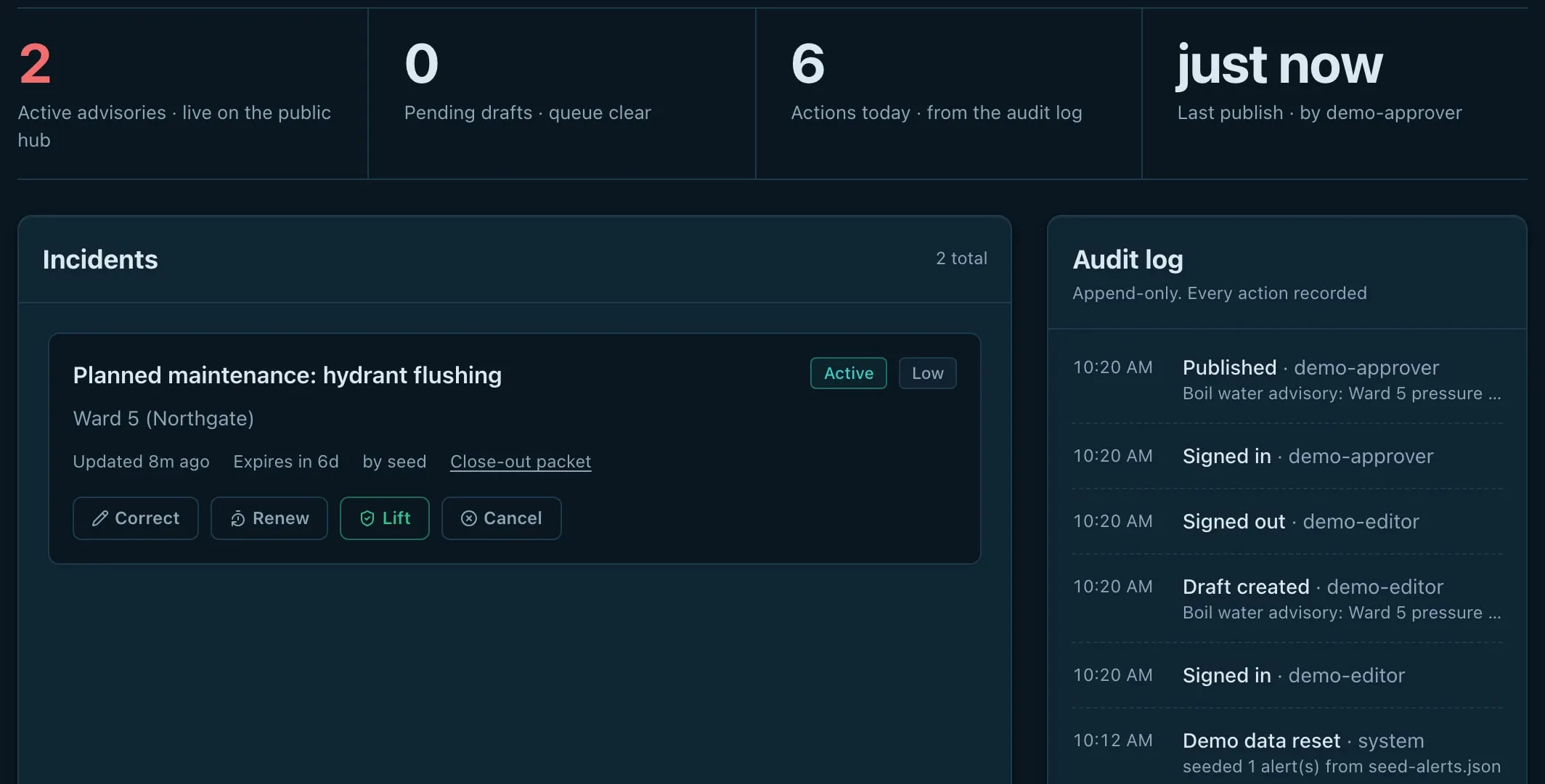
Pressure drops across Ward 5 while the town sleeps. The on-call editor signs in to a calm dashboard: one low notice about hydrant flushing, nothing else.
Day 1, 2:40 AM
The crew has confirmed the pressure loss. The wizard marks the hazard health-critical, counts Ward 5 households from the address layer, cites the utility’s own guidance, and starts the Tier-1 notice clock. As an editor, she can only save a draft.
Day 1, 2:52 AM
Revision one is frozen as issued, for the regulator. The append-only audit log takes two rows: drafted by the editor, published by the approver. The CAP alert gets its id.
Day 1, 2:53 AM
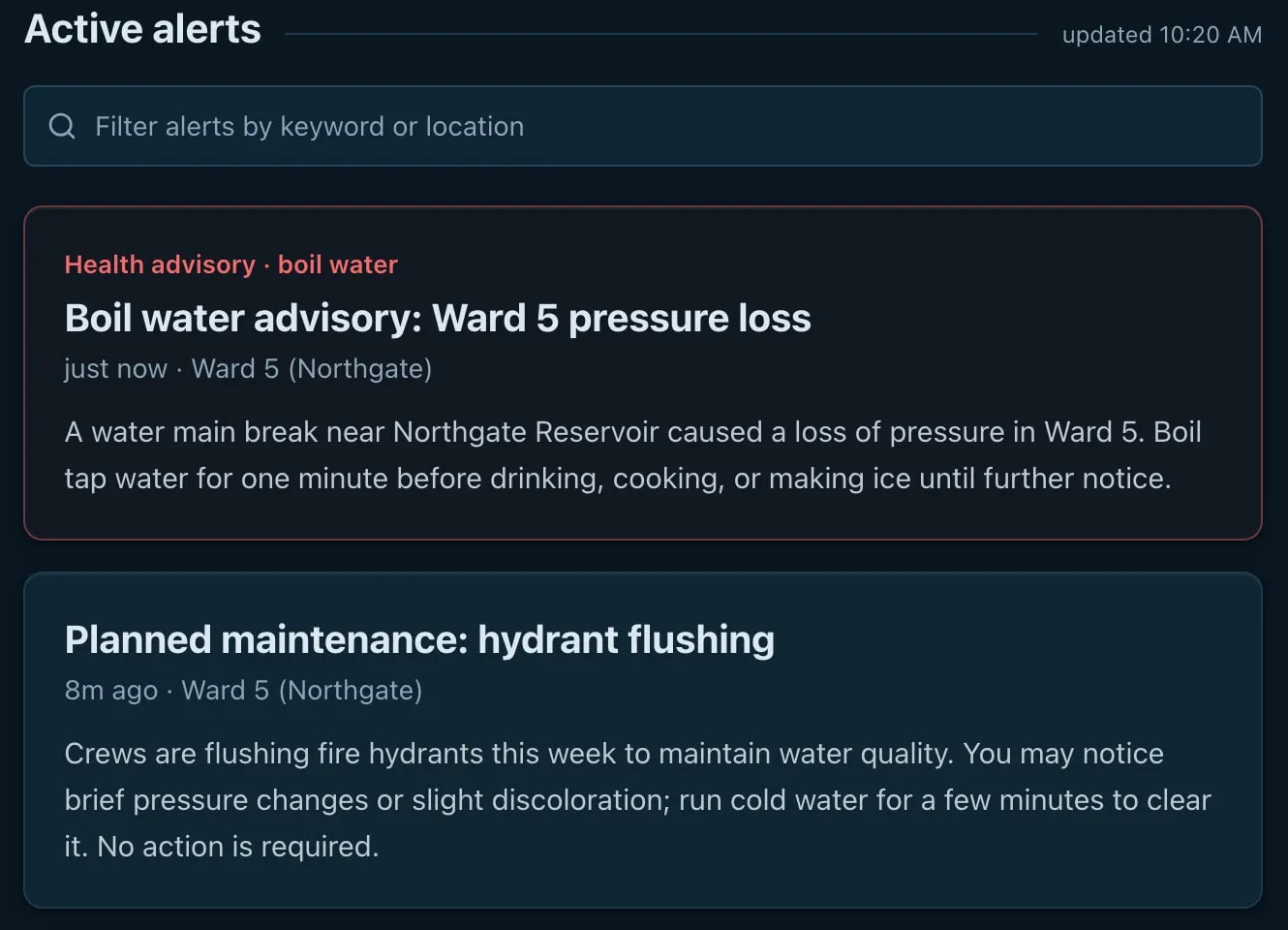
The status page turns red on its next poll. The widget on the utility’s website shows the banner, even to residents who dismissed an earlier notice. Every answer for Ward 5 now opens with the order. Riverton is still asleep.

Day 1, 7:30 AM
The first question in the widget is a parent’s, before the morning bottle. The answer opens with the order, in the utility’s own words, cited. Coffee, toothbrushes, the dog’s bowl: every answer starts the same way, and the phone line says it aloud.
Illustrative. The wording comes from the utility’s own documents; the system will not invent guidance.
Day 1, 9:40 PM
A health-critical advisory expires after 24 hours unless someone renews it. The dashboard has flagged this one since six hours out, and the approver renews it with one click. If nobody does, every channel turns amber: unverified. Never green.
Day 3, 4:02 PM
The approver records the all-clear with first-use guidance: flush cold taps for five minutes, discard the ice. The lift goes out as an update to the original alert, and for 48 hours every safety answer still carries it.

Day 3, 4:05 PM
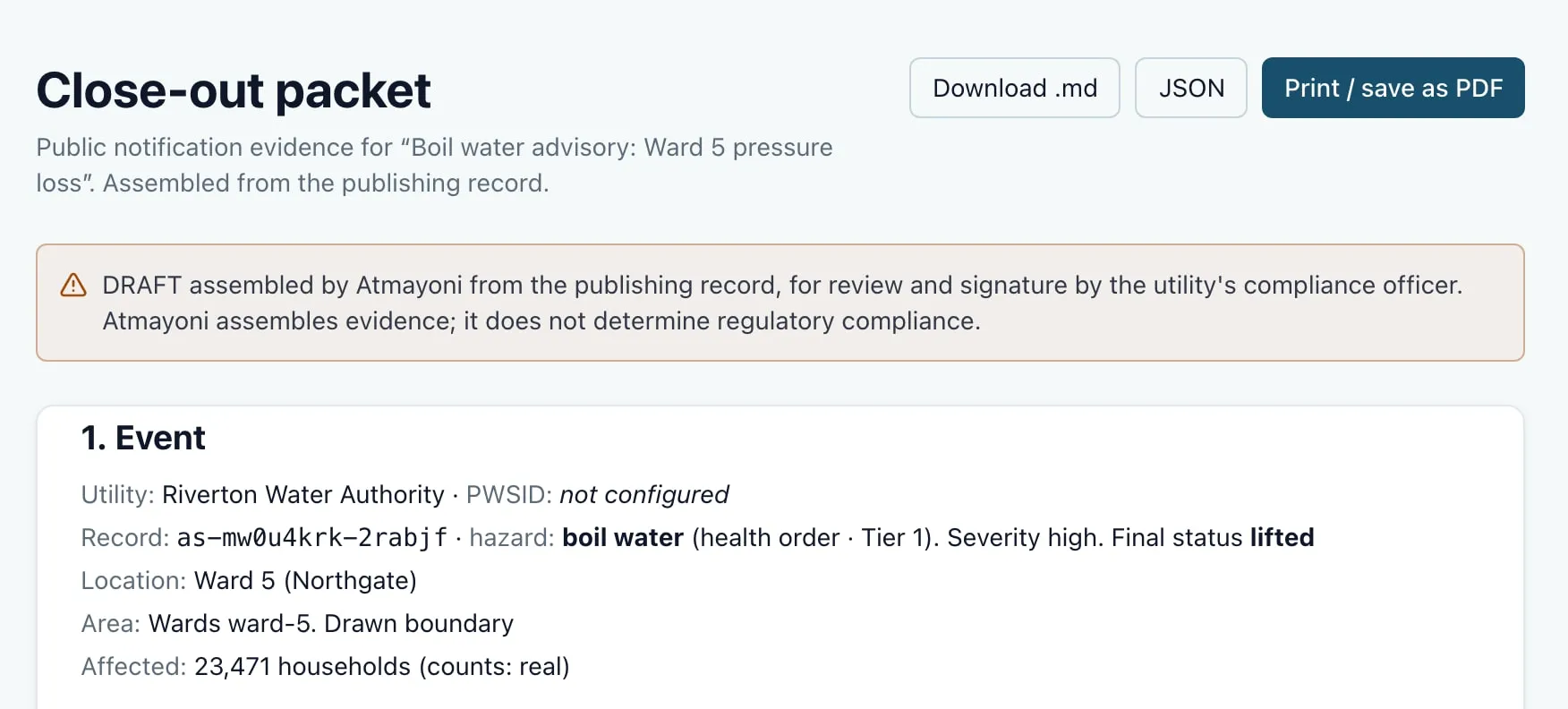
Named actors and timestamps. Each notice exactly as issued, with its alert id. The append-only audit trail. A certification draft, and a plain list of what the record still lacks. Print it, sign it, file it.
Three parts work in order: it reads your public documents, answers questions from them, and publishes advisories through an approval workflow. Two more connect it to the systems you already run.
Reads your website and PDFs, and keeps them current.
Answers questions from your documents, live advisories, and connected systems.
Drafts, approves, publishes, renews, and lifts advisories, with every step recorded.
Keep your chatbot, contact center, and phone system. They call Atmayoni for water facts and advisories.
Read-only connections to the systems you already run. If one is not connected or is down, the screen says so. It never fills the gap with made-up data.
No live utility system has been connected yet. Four of the six lookups run on simulated data shaped like production, and every screen labels them simulated.

The AI writes the wording. Code decides what has to be said, and the rules hold whichever model you use. Twenty live checks test them on every channel: publish, ask, escalate, lift, cancel, and confirm each screen told the truth. They run after any change to a safety path.
On every channel, every answer in the area starts with it. The AI cannot hide, soften, or contradict it.
A timer running out never turns anything green. Only a named person lifting it ends an advisory, with first-use guidance.
Every screen, and the API other bots read, shows the check could not run. Nothing claims safe without checking.
Every number comes from a document or a system record, or it is left out. Simulated data is labeled. A disconnected system reads not connected.
If it cannot tell whether an address is in the area, it shows the advisory. If it cannot tell whether an advisory is current, the page says unverified.
It works with the website, chatbot, and phone line you already have, and with the alert systems your vendors run.

Live advisories, affected-area map, address lookup, grounded answers, and a past-incidents feed that tells lifted from expired. Runs under your domain as your own deployment.
A banner ranked by hazard and an ask launcher, on the site you already have. No rebuild.
A resident types an address and sees everything the utility holds about it: advisories, location, service line, work nearby, water quality, account. The address is used for the lookup and not kept.
An API and an MCP server put Atmayoni behind Copilot Studio, Genesys, or any MCP host. Your chatbot keeps the conversation; Atmayoni supplies the water facts.
Spoken-form responses for IVR vendors. The caller at midnight hears exactly what the website says.
Standard Common Alerting Protocol output for mass-notification systems, with alert, update, and cancel chains. Advisories with a mapped area also flow to a Waze-compatible feed, so a main break shows where drivers look.
After a Tier-1 event, the regulator asks for proof. Atmayoni assembles it while the event runs, from each notice as issued and the audit trail, in seven chapters. When the advisory lifts, the packet is ready to review and sign. It is evidence; deciding compliance stays with you.
Export it as JSON or Markdown, or print the page to PDF.
Close-out packet
Boil water advisory: Ward 5 pressure loss
Draft assembled by Atmayoni from the publishing record. Atmayoni assembles evidence; it does not determine regulatory compliance.
We measured every figure below in August 2026 against the full public website of a major US water utility, about 1,900 pages and PDFs, used as a test corpus. None of it is a projection.
exercised across every channel, all passing
answered correctly with the model on
behind geo-scoped answers and household counts
harvested from one utility’s pages and PDFs, provenance-stamped
in our test runs, 1.8 s at the ninetieth percentile
telling current documents from superseded ones, on a hand-labeled benchmark
Anything else, email us. We answer from the code, not a slide deck.
hello@atmayoni.comNo. The status page runs as your own deployment. The widget is one script tag on your existing site. The API and MCP server sit behind the chatbot or IVR you already run. Nothing is ripped out.
Code outside the model enforces the safety policy. Every question consults the live advisories and puts them first, in a block the model cannot alter. If the prose drops a hazard verb, negates it, or invents a number, the system discards it and answers from the source text. Twenty live assertions exercise this across every channel.
Your own public record: the pages and PDFs your staff curate into a knowledge base, your live advisories, and the systems you connect. If nothing verified matches, the answer says so instead of guessing.
Whichever you choose. One seam supports OpenAI-compatible endpoints, self-hosted models such as vLLM or Ollama, and Anthropic. Every call is priced and capped by a hard budget. Without any key the system still runs, answering from source text. We have run it live on one OpenAI model so far; any other provider becomes supported for you only after it passes our evaluation gate.
In your own isolated deployment, inside your network or on infrastructure dedicated to you. Resident addresses are used for the lookup and not kept; the question log stores a redacted question and a ZIP code. We never train on your corpus. With a hosted model, the provider’s API terms govern; with a self-hosted model, nothing leaves your network except the public geocoder call.
Ninety days, read-only. You give read access to your public website and, if you choose, one GIS feature service, one work-order feed, and one billing extract. We provide the containers, a capped model budget, and the packets. Procurement is a data-sharing agreement.
A working system under a fictional utility, Riverton Water, with every screenshot on this page captured from it. We are looking for a small number of design partners for the read-only pilot.
We are looking for two or three utilities for a 90-day, read-only pilot.
The walkthrough uses the working software, not slides.